



Being involved in a car crash can be overwhelming, especially when questions arise about who caused the collision. If you suspect you may be partially responsible for a car accident, you might wonder whether you can still pursue a claim for your injuries and losses. The answer depends largely on where the accident occurred and how your state handles shared fault.
Quick Answer: Can You Still Bring a Car Accident Claim If You Were Partly at Fault?
In most U.S. states, partial fault does not automatically erase your ability to seek compensation after a car crash. Many collisions involve shared responsibility—perhaps one driver was speeding while the other driver failed to yield. Comparative negligence or comparative fault rules typically reduce, rather than eliminate, what you may potentially recover.
The impact on your car accident claim depends heavily on state laws. States follow one of three systems: pure comparative negligence, modified comparative negligence, or contributory negligence. For example, if you are 30% at fault in a $40,000 claim under a pure comparative negligence rule, you might still recover damages up to $28,000 (the remaining 70%). However, in a contributory negligence state, even minimal fault could bar recovery entirely.
If you have questions about how your state’s laws apply to your situation, you can request a free consultation in Spanish with an independent car accident lawyer in our network. Los Defensores is a legal advertising service that helps connect people with independent attorneys—we do not provide legal representation ourselves.
What “Partially at Fault” Means in a Car Accident
When more than one driver’s actions contributed to a collision, insurance companies and courts may assign partial liability to each party involved. Determining fault is rarely straightforward, as multiple factors often play a role.
- A driver who was speeding may share fault with the driver of the other car if that driver made an unsafe lane change
- Distracted driving by one motorist combined with failure to yield by the other party can result in shared fault
- In rear end collisions, the following driver typically bears responsibility, but the lead vehicle (the other car) may share fault for braking suddenly without working brake lights
- Weather conditions, mechanical failures, or a defective vehicle component can complicate fault percentages
- Fault assigned in percentages (such as 60% vs. 40%) determines how much each insurance company may pay
Consider a concrete example: on the I-5 in Los Angeles during rush hour, an injured driver rear-ends another vehicle. Investigation reveals the front driver (the other car) braked abruptly without operational taillights, while the following driver was traveling too closely. Both the injured driver and the driver of the other car could be partially responsible for the events leading to the crash. In some accidents, multiple parties may share fault, especially when several vehicles are involved.
Comparative Negligence, Comparative Fault, and Contributory Negligence
U.S. states follow different systems for handling shared fault in car accident claims. These are known as fault based systems, meaning that responsibility for the accident is determined by analyzing each party’s actions and the available evidence. Understanding these comparative negligence rules can help you gauge how fault might affect your potential recovery.
Pure Comparative Negligence
Under pure comparative negligence, you can recover compensation even if you are 99% at fault, with your payout reduced by your fault percentage. States like California, New York, and Kentucky follow this approach. For instance, a driver in California who is 70% at fault in a crash on the 405 freeway could still pursue 30% of their losses from the other driver.
Modified Comparative Negligence
In modified comparative negligence states, you can only recover money if your fault is below a specific threshold, usually 50% or 51%. Texas, Florida (post-2023 reforms), and Kansas use this system. If you are found to be 50% or more at fault in Kansas, you are completely barred from recovering any damages. Missouri operates under a pure comparative fault system, allowing recovery regardless of the percentage of fault.
Contributory Negligence
Contributory negligence is a strict rule that bars you from receiving any compensation if you are even 1% at fault. States like North Carolina, Virginia, Maryland, and Alabama follow this approach. A driver running slightly over the speed limit—even just 1 mph—might be prevented from civil recovery against the other driver.
Different states have varying approaches to shared fault in car accidents. An experienced attorney in your state can clarify which system applies to your personal injury case.
How These Rules Change the Value of Your Car Accident Claim
The percentage of fault assigned to each party involved directly affects potential compensation. Even small differences in fault can lead to a significant difference in financial recovery.
- 10% fault on a $50,000 claim: Under pure comparative negligence, you might recover up to $45,000. Under modified comparative negligence with a 51% bar, the same result applies.
- 30% fault on a $50,000 claim: Your potential recovery drops to $35,000 under both pure and modified systems (assuming you remain below the threshold).
- 60% fault on a $50,000 claim: In a pure comparative negligence state like New York, you could still recover $20,000. In a modified state like Texas, you would be barred from recovering any damages.
These reductions apply to all major damage categories: medical bills, lost wages, property damage, and potentially pain and suffering. In contributory negligence states, accident victims may rely more heavily on their own insurance coverage—such as MedPay, PIP, or collision—when any fault is assigned to them.
How Fault Is Determined After a Car Crash
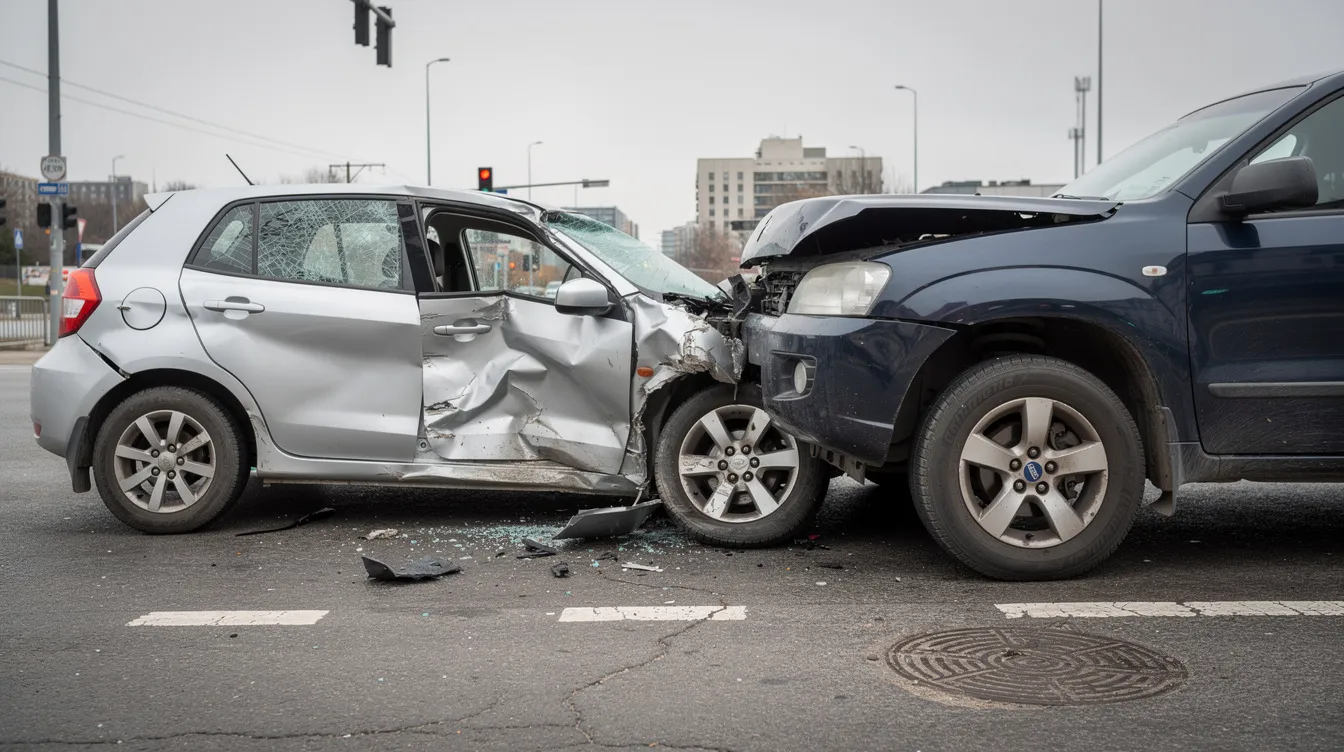
Establishing fault typically begins with insurance companies conducting thorough investigations. To determine fault, insurance companies gather statements from drivers, review police reports, and interview witnesses. If the case proceeds to court, judges or juries may make the final determination.
Key evidence sources include:
- Police reports documenting the crash scene, traffic violations, and officer observations
- Photographs and videos showing vehicle damage, skid marks, and road conditions
- Traffic camera footage capturing the moments before and during impact
- Witness statements taken promptly—preferably the same day—to preserve accuracy
- Physical evidence like damage patterns indicating impact angles and repair invoices
- Medical records documenting injuries sustained in the collision
Gathering evidence at the scene—such as taking photos, collecting witness information, and noting road conditions—can significantly strengthen your case if liability is contested later.
Insurance adjusters review evidence such as police reports and witness statements to assign a fault percentage to each driver. Accident reconstruction experts may be used to analyze the crash and provide insights into how the accident occurred, which can be crucial in determining fault percentages. Courts may also consider whether a driver ran a stop sign or red light as part of determining fault.
If you believe an insurance adjuster has unfairly blamed you for a collision, you have the option to dispute the fault assigned.
Common Scenarios Where Drivers Share Fault
Several situations commonly result in shared responsibility:
- Multi-car rear-end collisions: The lead vehicle may bear partial fault for abrupt braking, while each following driver shares responsibility for inadequate following distance
- Lane-change crashes on freeways: One driver may change lanes unsafely while another fails to maintain consistent speed
- Four-way stop sign confusion: Both drivers may proceed simultaneously, each partially at fault for failing to properly yield
- Left-turn accidents: One driver turns on a yellow arrow while the oncoming driver accelerates to “beat” the red light
Weather conditions like rain or fog, poor lighting, or construction zones can further complicate determining fault. A November 2024 intersection crash in Los Angeles illustrated this complexity: the turning driver and the oncoming driver each contributed to the collision through their respective actions.
How Partial Fault Can Affect Your Insurance Claim and Compensation
Even if you are partially at fault, you may still submit insurance claims to your own insurer and potentially to the other car’s insurer, depending on state law. Comparative negligence rules typically reduce any settlement by the same percentage as your assigned fault—25% fault means a 25% reduction. Insurance companies often try to limit payouts by shifting blame onto the injured party, arguing that you are more responsible for the accident than the other driver, which can make it harder to obtain fair compensation.
If you are found partially at fault for a car accident, the consequences typically fall into three categories: reduced compensation, insurance changes, and legal liability.
Insurance Premium Effects
- Insurance companies often view individuals who are partially at fault as higher-risk drivers, potentially leading to increased premiums
- Premium increases due to being partially at fault can be significant—sometimes by as much as 41%
- Loss of discounts such as “good driver” discounts or “accident forgiveness” benefits can occur
- The accident will likely appear on your driving record for approximately 3 to 10 years, which can affect your eligibility for certain jobs or licenses
No-Fault States
In no-fault states, your own Personal Injury Protection (PIP) covers your medical bills regardless of fault, up to a certain limit. However, fault still matters for claims exceeding PIP limits or for property damage.
Potential Personal Liability
If damages exceed your insurance policy limits, you could be personally responsible for paying the remaining balance out-of-pocket.
If you are in a shared-fault situation, documenting evidence such as photos of the scene is important to ensure fault is not disproportionately assigned to you. Medical records, photographs from the scene, and repair invoices are key forms of evidence that can limit a driver’s percentage of responsibility.
Examples of How Fault Percentages Change a Car Accident Claim
Pure Comparative Negligence Example (California)
An injured driver in an $80,000 claim is found 45% at fault for distracted driving. Under California’s pure comparative negligence rule, they could potentially recover up to $44,000 (55% of total damages) for medical expenses, lost wages from a warehouse job, and repairs to their 2019 Honda Civic.
Modified Comparative Negligence Example (Texas)
A driver in Texas faces a $30,000 claim after a collision where they ran a stop sign. If found 40% at fault, they might recover $18,000. However, if their fault exceeds 50%, they recover nothing from the other party under Texas law.
Contributory Negligence Example (Virginia)
An injured driver with $100,000 in damages is determined to be just 5% at fault for traveling 36 mph in a 35 mph zone. In Virginia’s contributory negligence system, this minimal fault may bar them from recovering any damages from the other driver, regardless of the other driver’s conduct.
What to Do After a Car Accident If You Might Be Partly at Fault
Immediate steps taken at the scene can influence how fault is determined later.
- After a car accident, it is crucial to call the police to document the incident and establish an official report, which can be vital for any future claims
- Seeking medical attention immediately after an accident is important not only for your health but also for documenting any injuries that may arise
- Gathering evidence at the scene, such as taking photos, collecting witness information, and noting road conditions, can significantly strengthen your case and help support your claim for a fair settlement
- Exchange information: names, phone numbers, license plates, and insurance details from all parties
- Avoid admitting fault or speculating about what happened—stick to basic facts
- Note any traffic lights, stop signs, weather conditions, or mechanical failures you observed
Communicating With Insurance Companies When Fault Is Unclear
Contacting your insurance company promptly after an accident is usually required and helps ensure your claim is processed in a timely manner.
When speaking with insurance adjusters:
- Provide truthful, concise descriptions of the accident
- Avoid phrases like “It was all my fault” or “I should have been more careful”
- Do not speculate about speed, distances, or whether you were paying attention until reviewing the police report
Insurance companies often employ tactics to limit payouts by shifting blame onto the injured party. Adjusters may downplay the severity of injuries, claiming they are minor or unrelated to the accident. Insurance companies often make low settlement offers quickly after an accident, which may seem beneficial but are typically much lower than the actual value of the claim.
How a Car Accident Lawyer Can Help If You Were Partially at Fault

Many people assume they have no case if they share blame, but an experienced personal injury attorney may identify evidence that reduces their fault percentage.
A car accident attorney may assist by:
- Reviewing police reports and identifying inconsistencies
- Requesting traffic camera footage before it is deleted (often retained only 30 days)
- Interviewing witnesses and gathering witness information promptly
- Consulting accident reconstruction specialists to present strong evidence about how the collision occurred
- Interpreting comparative negligence rules in your state
- Identifying all available insurance policies (liability, UM/UIM, PIP, MedPay)
- Handling communications with insurance adjusters who may misinterpret evidence to unfairly increase your share of fault
In many personal injury cases, attorneys may work on a contingency-fee basis, meaning legal fees are collected only if there is a recovery. However, clients might still be responsible for case costs. Results vary based on individual circumstances.
Los Defensores helps connect Spanish-speaking accident victims with independent car accident attorneys who can explain these issues in Spanish during a free consultation.
When It May Be Especially Important to Talk With an Attorney
Consulting with a car accident attorney can provide guidance through the legal process, helping you understand your rights after an accident. Consider reaching out when:
- You sustained serious injuries requiring surgery, physical therapy, or ongoing medical treatment
- The crash involved a fatality or suspected drunk driving by the other driver
- Police reports appear incomplete or inaccurate
- Fault is heavily contested, such as in multi-vehicle pileups
- Commercial vehicles or rideshare drivers were involved
- You need help documenting lost wages, especially if paid in cash
Laws and deadlines (statutes of limitation) vary by state, so speaking with an experienced attorney promptly can help preserve your legal options.
How Los Defensores Helps Connect You With Legal Support
Los Defensores is a national legal advertising service focused on connecting Spanish-speaking individuals in the U.S. with independent personal injury attorneys. We are not a law firm, do not provide legal advice, and all legal services are provided by independent attorneys in our network.
If you have been in a car accident—whether recently or in the past—and are partially at fault, you can contact Los Defensores online or by phone to request a free, confidential consultation in Spanish. Consultations can help you understand how comparative negligence or contributory negligence in your state may affect your car accident claim.
Consulta Gratis Ahora – Habla con un abogado hoy. Assistance is available regardless of immigration status.
This article is for general informational purposes only, is not legal advice and does not create an attorney-client relationship. Results vary based on the specific facts and law applicable to each case. This content was created with AI assistance and reviewed for accuracy, including the images contained herein. Hiring a lawyer is an important decision and should not be based solely on ads. No claim is made that participating attorneys are better than others.