



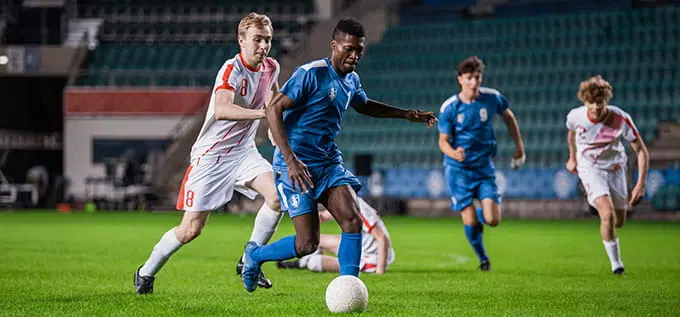

Speed, anticipation, strength, game intelligence, leadership, and the refusal to give up. The same qualities that define a great defender on the field are, surprisingly, the same ones that define a great defender anywhere else.
The forward gets the applause. The defender gets the result. That’s, in a nutshell, the most unfair truth in soccer: the goal gets celebrated, replayed, turned into a headline.
The defensive play that prevented that same goal — the early read, the perfectly positioned body, the right decision in a split second — almost never gets mentioned.
And yet, without that play, there’s no win.
So what makes a great soccer defender?
It’s not just physical strength or the ability to win a duel. It’s a combination of skills that very few players manage to master all at once. Let’s break them down — and explore why those same qualities are what set apart the people who defend something far more important than a scoreline.
Speed: Getting There Before It’s Too Late
A defender’s speed isn’t just measured in how fast they run.
It’s measured in the ability to get to the right place at the exact right moment — and that positioning allows them to anticipate before danger materializes without having to sprint. A defender who’s slow to react, even if they’re fast in a straight line, always arrives a step late. And in soccer, one step late is the difference between a clean tackle and a goal against.
Lowering your center of gravity also improves agility in changes of direction and short duels. Angling your body toward the opponent’s weaker foot helps control the play without losing balance.
That same speed of reaction is what sets apart a good attorney. Cases don’t wait. Critical decisions — a call that needs an immediate response, a document that has to be filed before a deadline, a negotiation that’s moving faster than expected — demand the same ability to act without delay.
Speed, in both arenas, isn’t just physical: it’s the urgency of understanding that every second lost could cost something important to the person you’re defending.
Anticipation: Seeing the Play Before It Happens
The greatest defenders in soccer history don’t necessarily stand out for winning more physical duels. They stand out for needing fewer — because they’re already in the right place before the forward receives the ball.
That’s anticipation: reading the opponent’s intent and knowing whether to hold the individual mark or close ranks as a unit, calculating the ball’s trajectory, understanding the other team’s pattern of play before it fully develops.
That read demands tactical intelligence to decide when to cover and close down. It also requires disciplined focus, because unwavering concentration prevents fatal errors — and in certain contexts, zonal defending reduces fouls and physical wear.
Legal anticipation works exactly the same way. A good attorney doesn’t wait for the problem to explode before acting. They study the case ahead of time, identify risks before they become a crisis, and prepare the defense thinking several moves ahead — just like a center-back who already knows where the ball is going before the striker touches it.
Preparation is what separates someone who solves a problem from someone who simply survives it.
Strength: The Foundation Everything Else Is Built On
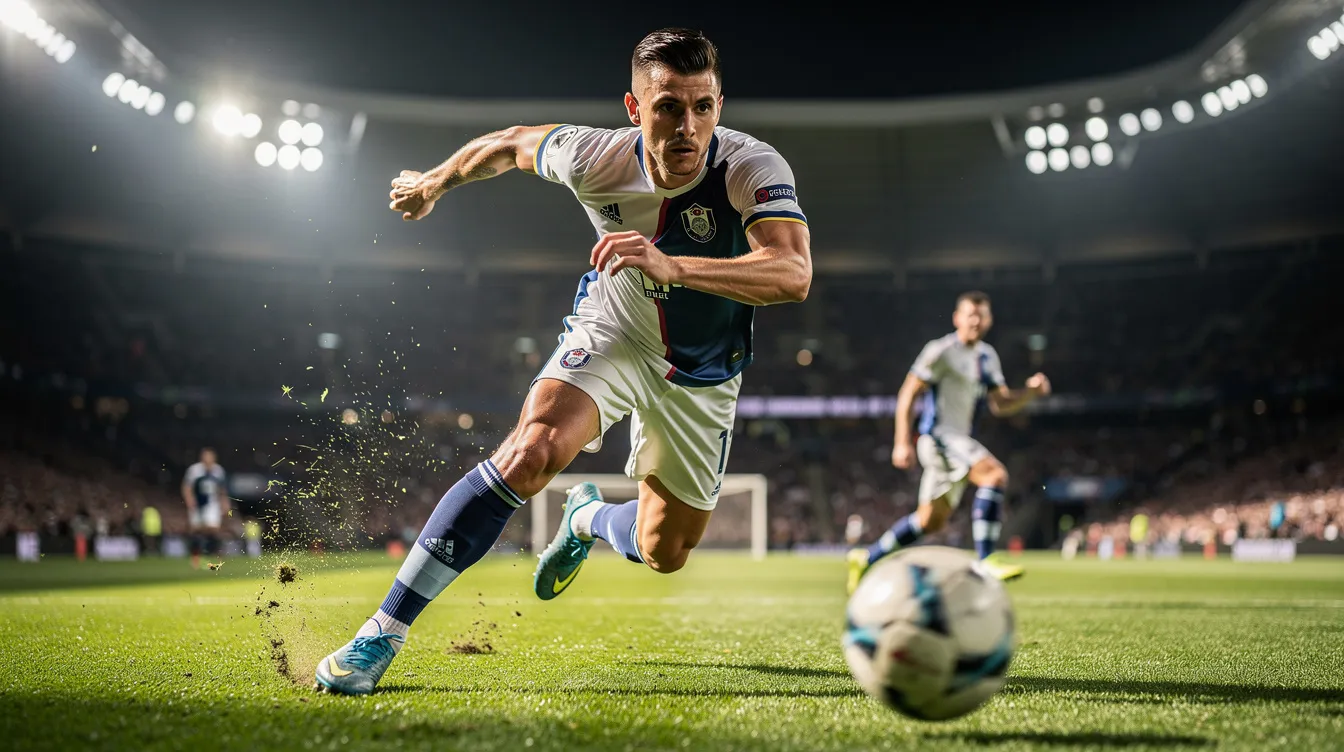
A defender’s physical strength isn’t just about muscle. It’s the ability to hold your position under pressure, to not get pushed off the spot where you need to be, and to impose yourself in the box — especially when defending crosses and contesting 50/50 balls — without losing balance or control.
It also takes courage and sacrifice to block shots when the play demands putting your body on the line. A defender who goes down at the first contact can’t do their job, no matter how much they know about tactics. And that well-applied strength also supports clean build-up play — because with good passing technique, a defender can start the attack from the back with precision.
Strength in the legal arena is the determination not to fold under pressure.
Difficult cases come with pressure from every direction: the other side, the deadlines, the uncertainty of a client who needs answers. A defender — on the field or in the legal system — who gets rattled at the first difficulty can’t protect the person depending on them. Strength, in both cases, is the foundation that holds everything else together: the technique, the strategy, the final result.
Reading the Game: Understanding the Full Picture
A center-back who only watches the ball is destined to make mistakes — especially because they operate on the last line of defense.
Great defenders see the entire field: the positioning of their teammates, the gaps the defensive line is leaving, the movement of forwards who don’t have the ball yet but are getting ready to receive it.
That panoramic vision is what allows them to anticipate, communicate with the defense, and make decisions that go beyond the immediate play. It also helps ensure that passing technique serves to start the attack from the back with precision.
In the center of the box, aerial ability is crucial for defending crosses and set pieces, and a center-back must master it. The sweeper fills a freer role, without strict marking duties in the defense. Meanwhile, a stopper steps ahead of the last defender to press the attacker and must be quick enough to cover wide areas while maintaining the right distance.
That same ability to read the full picture is essential in legal defense.
It’s not enough to know the specific case — you have to understand the complete context, the consequences of each decision, how one strategy affects another. An attorney who only sees the immediate problem, without considering the full picture of the case and the life of the person they represent, runs the same risk as a defender who only watches the ball: they lose sight of what really matters.
Leadership: The Role That Organizes When Everything Gets Complicated
On any team, center-backs tend to be the ones who communicate, organize, and direct the most during a match.
That’s no coincidence. Defense requires constant coordination: calling out a runner coming from behind, signaling who should cover a space, keeping the line organized when the opposing attack turns chaotic. A defender who doesn’t lead, who doesn’t communicate, leaves the entire team exposed.
That leadership also shifts depending on the team’s formation and the responsibilities each system assigns to the back line. In that sense, understanding what makes a great soccer defender means recognizing that their key contribution brings together physical, technical, tactical, and psychological attributes.
Leadership in legal defense works the same way. The people who need protection most — those facing a system that often overwhelms them in resources and information — need someone who takes control of the situation, who maps out the path forward, who tells them clearly what to do and when to do it.
Leading isn’t about imposing — it’s about providing the assurance that someone with knowledge is at the front, watching over every step.
The Refusal to Give Up
There’s one final quality that separates the great defenders from the merely good ones: the decision to never give up, even when the game seems lost.
The defender who keeps running to recover a ball that seems impossible to reach, who throws themselves to block a shot in the final second, proves that commitment defines the position beyond the scoreline.
On the wings, that effort also demands repeating defensive cover runs again and again. Wing-backs, for example, combine full-back and midfield functions in attack, while traditional full-backs typically wear the number 2 or 3.
The one who keeps fighting for every ball until the final whistle, regardless of the score — that commitment is what turns a defender into a legend for their fans.
That same commitment, that refusal to quit, is exactly what defines a lawyer who is truly dedicated to their community.
The hardest cases — the ones that seem lost from the start, the ones that face every obstacle the system can throw at them — are precisely the ones that need someone who won’t give up.
The difference between defending someone halfway and defending them all the way is the same difference between the defender who accepts the result and the one who fights for every ball as if it were the last play of the match.
The Parallel That Connects Two Ways of Defending
Soccer and legal defense couldn’t seem more different at first glance — and each form of defending shifts depending on the context of the game.
One is played on a field, with a ball and a scoreboard. The other is played in courtrooms, with documents and decisions that change entire lives.
But the qualities that make a great defender are surprisingly identical in both arenas: the speed to act in time, the anticipation to prevent the problem before it happens and cut off the attackers’ advance, the strength to not fold under pressure, the vision to understand the full picture, the leadership to guide those who need it, and the determination to never give up — no matter how difficult the play seems.
In soccer, a great defender protects their team’s goal and often prevents what could have been.
In real life, a great defender protects the people who need it most.
And that, in the end, is the mission of Los Defensores: to be there, with the same qualities that make any defender great — ready to anticipate, ready to stand firm, and above all, never giving up until the final whistle.
This article is for general informational and educational purposes only. It is not legal advice and does not create an attorney-client relationship. For guidance specific to your situation, please consult with a licensed attorney. The soccer comparisons used in this article are for illustrative purposes only and do not guarantee or predict legal outcomes. Results vary based on the specific facts and law applicable to each case. Hiring a lawyer is an important decision and should not be based solely on ads. No claim is made that participating attorneys are better than others.