



If you grew up in a Latino household, you already know. If you didn’t, consider this your official introduction.
It doesn’t matter if it’s 2026, 1998, or any year when the World Cup takes over. In a Latino home, when the tournament starts, the rules change. The house changes. The people change. Everything changes.
There are things that simply don’t happen in any other context — not at Christmas, not at birthdays, not at any other time of the year. Only during the World Cup. And if you grew up watching it with your family, we’re pretty sure you’ll recognize every single one of these.
1. The Tío Who Knows More Than the Commentator
Every Latino household has a tío — or a grandpa, or a cousin, or a brother-in-law — who analyzes every play like he’s the team’s head coach. He questions the manager’s decisions. He yells “I WOULD’VE TAKEN HIM OUT IN THE FIRST HALF!” as if Scaloni or Tata Martino could actually hear him.
The tío does not accept opposing opinions. The tío already predicted everything before it happened. And if the team loses, the tío has proof that he called it. “See? What did I tell you? I said it.”
2. The Food Starts Before the Game and Never Ends
In a Latino home, a World Cup match is not a sporting event. It’s a gastronomic event with soccer playing in the background.
The cooking starts hours before kickoff. Tacos, empanadas, guacamole, tequeños, yuca frita — everything appears on the table like magic. Nobody knows exactly who cooked what, but it’s all there.
And just when you think it’s over, someone brings out more food. There’s always more. Because in a Latino home, running out of food during a match is worse than conceding a goal.
3. The TV Volume Is Maxed Out (and Nobody’s Allowed to Lower It)
In a Latino home, the volume of the game is non-negotiable. If you can’t hear the commentator from the kitchen, it’s too low. If the neighbors don’t know who’s winning, it’s too low.
And no matter how many times someone says “turn it down a little” — that’s not happening. The volume goes down when the game ends. Not before.
The goal celebration has to feel like you’re in the stadium. That’s the law.
4. Someone Cries (and Not Just When They Lose)
Latinos feel soccer in a way that’s hard to explain. You cry when you lose, obviously. But you also cry when you win. You cry when the national anthem plays. You cry when your team makes it to the Round of 16 after years of missing the World Cup.
And your abuelita is the first one to cry. Because she remembers every World Cup that came before. For her, every goal is a memory, a story, a piece of her life.
Nobody judges World Cup tears. They’re sacred.
5. The One Who Has to Watch From the Other Room
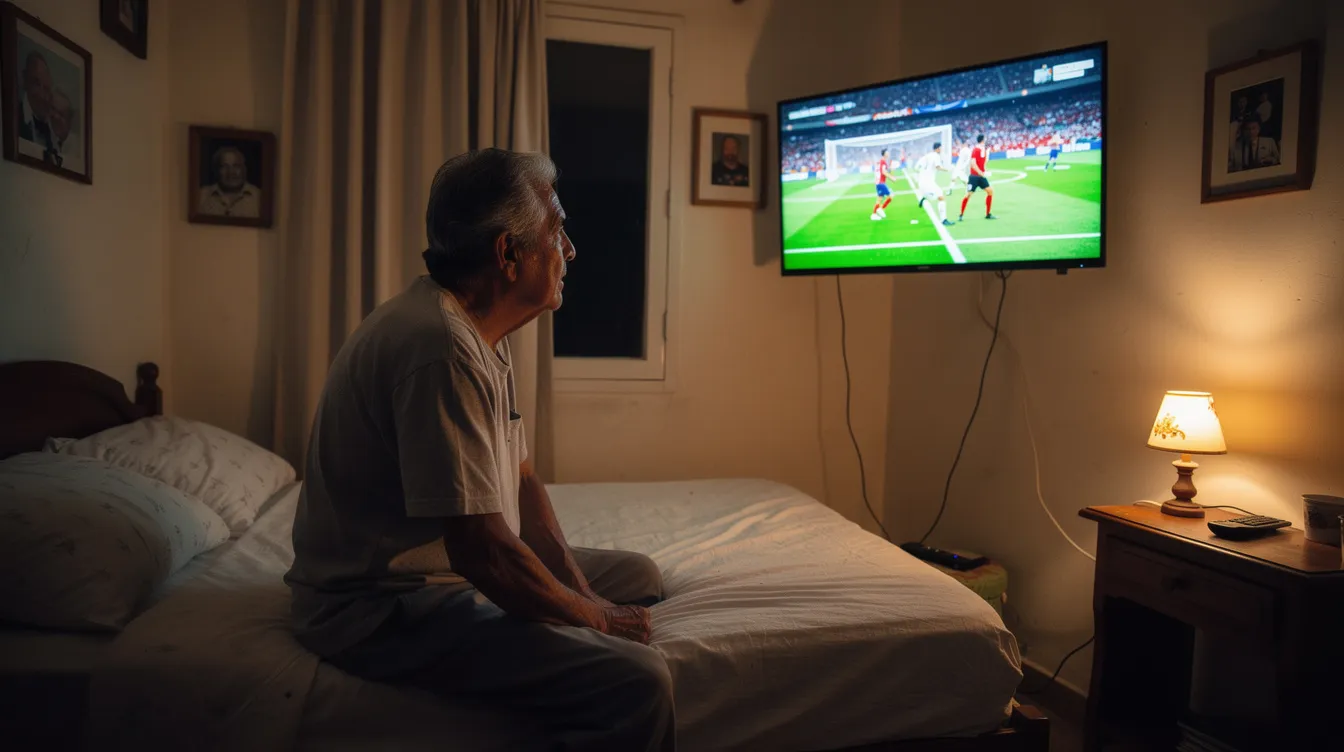
Every Latino family has someone who brings bad luck. The mufa. The salado. The person who, every time they sit down to watch, the team loses.
It doesn’t matter if it’s your brother, your sister-in-law, or your best friend. If the data confirms it — and in a Latino family, someone is always keeping track — that person watches the game from another room. On their phone. In silence. No complaints.
“It’s not personal. It’s for the team.”
6. The Cábalas Are Respected Like Commandments
The jersey doesn’t get washed. The seat doesn’t change. The veladora stays lit. The same meal gets cooked again if we won. The same lucky underwear goes back on.
Nobody questions the cábalas. Not even the most skeptical member of the family dares to break a winning streak just to “be logical.” In a Latino home during the World Cup, logic goes on vacation and superstition takes charge.
And if someone breaks a cábala and the team loses, that person carries the blame until the next tournament. Four years of guilt. Minimum.
7. The Kids (and Some Adults) Don’t Understand Anything but Scream Anyway
The youngest ones in the house have no idea what offsides is, don’t know why the referee pulled out a card, and probably can’t name a single player who isn’t Messi.
But when everyone screams, they scream. When everyone jumps, they jump. When everyone hugs, they hug. And when the whole room goes silent waiting for a penalty kick, they go quiet too — even if they don’t know why.
8. Your Mom or Abuelita Walks In at the Exact Moment of the Goal
She said she wasn’t interested in soccer. She said she’d be doing other things. She said “let me know if anything happens.”
And right at the moment of the goal — the deciding goal, the winning goal — she walks into the room and asks, “What happened?”. And everyone screams “GOOOOOL!” at her like she’d been there since the first minute.
The funny thing is, she stays. And she ends up watching the rest of the match with more intensity than anyone else. Because in a Latino home, the World Cup always finds the people who claim they’re “not interested.”
9. Halftime Is a More Serious Strategy Meeting Than Anything at Work
The first five minutes of halftime are for bathroom breaks and food refills. The next ten are for analysis.
“He needs to bring in the striker.” “That fullback can’t keep playing like this.” “If he doesn’t change the formation, we lose.” Everyone has an opinion. Everyone is a coach. Everyone knows exactly what needs to happen to win.
And if the team wins in the second half, everyone takes credit for having “said exactly what they needed to do.” If they lose, it’s the manager’s fault. Never the halftime analyst’s.
10. The Neighbors Know the Score Before Checking the TV
In a Latino home during the World Cup, a goal can be heard three houses away. The screams, the jumping, the clapping, the “¡GOOOOOOL!” that lasts fifteen seconds. The neighbors don’t need to watch the game. They just need to wait for the noise.
And if there’s sudden silence after a lot of noise… the neighbors know something bad happened.
The World Cup in a Latino home is not a private event. It’s an involuntary community event. The neighbors participate whether they want to or not.
11. After the Game, Nobody Leaves
The match is over. The post-game analysis is done. The cábalas have been evaluated. But nobody leaves.
Because in a Latino home, the game is the excuse. What really matters is being together. The cafecito after the match. The conversation that keeps going. The memories of World Cups past. Abuelo’s stories about the goal nobody will ever forget.
The World Cup in a Latino home isn’t just soccer. It’s family. It’s memory. It’s tradition. And it’s probably one of the most beautiful things you’ll experience this summer.
This Summer, the World Cup Is Happening at Home
And what if the best place to experience it was your own home — with a 65″ TV, $500 for food delivery, and a party for 20 guests, all included?
Enter the Los Defensores Gran Fiesta Futbolera sweepstakes.
Enter to Win!
Los Defensores is always with you. Defending the moments that matter most.
Did you see yourself in any of these? Share this article with your family and friends!
This article was created for entertainment purposes. The situations described reflect common experiences in Latino households and may vary depending on the country, the family, and your tío’s level of soccer intensity.