



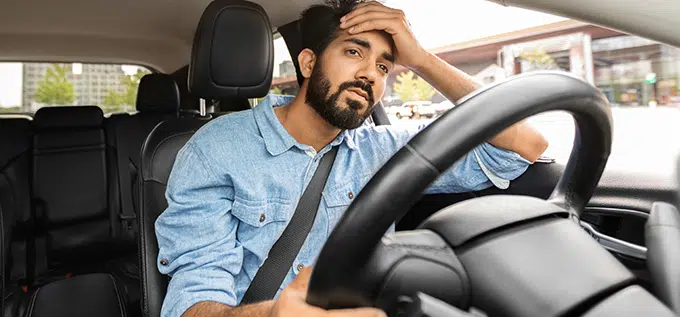

Driving Without a License: Key Things You Need to Know Right Away
Operating a motor vehicle on public roads without a valid license is illegal in every U.S. state. Driving without a license is considered a crime in all states and is typically classified as a misdemeanor, which can result in fines, a criminal record, vehicle impoundment, and even jail time. This violation can create serious legal and financial consequences, especially if you’re involved in a car accident while unlicensed.
When people talk about driving without a license, they’re often referring to several distinct situations:
- Never obtaining a license – You never passed the required tests or applied for a driver’s license
- Driving with an expired license – Your license was valid but has since lapsed
- Operating with a suspended or revoked license – Your driving privileges were taken away due to prior violations, unpaid fines, or other legal issues
Each scenario carries different penalties, but all can lead to significant problems and increase your risk of facing criminal charges.
Common immediate consequences include:
- Traffic tickets and fines (ranging from around $100 to several thousand dollars depending on the state and circumstances)
- For first-time offenders, you typically pay fines ranging from $50 to $500, but a hefty fine is possible depending on the state and circumstances.
- Possible arrest, particularly for a suspended license
- Having your car impounded
- A requirement to appear in court
- Points on your driving record or criminal record entries
In states like California and Texas, penalties can escalate quickly. California Vehicle Code violations may result in fines from $300 to $2,000 and potential jail time for aggravated cases. Texas treats a first offense as a Class C misdemeanor with fines up to $200, but a second or subsequent violation—or driving without insurance—can bump charges to a Class B misdemeanor with fines up to $2,000 and possible jail exposure.
There is a significant risk of being found guilty in court if you are caught driving without a license. A guilty verdict can mean you must pay fines, court costs, and may end up with a criminal record.
One critical issue many people overlook: unlicensed drivers typically lack valid car insurance coverage. Most policies require a current license, so if you’re in an accident while unlicensed, your insurer may deny your claim entirely. Being found guilty of driving without a license can also increase your insurance premiums. This leaves you personally responsible for damages and complicates injury compensation for everyone involved.
Los Defensores is a legal advertising service that helps connect Spanish-speaking consumers with independent car accident and personal injury attorneys across the U.S. These attorneys offer free consultations in Spanish to help you understand your options.
If you were injured by an unlicensed driver—or if you were unlicensed at the time of a crash—consider requesting a free, confidential consultation today to learn what legal options may be available.
Attorney [Name] of [City, State] is responsible for this advertisement. This article was created with the assistance of AI.
Is Driving Without a License Illegal?
Yes. Every state requires a valid driver’s license to operate a motor vehicle on public roads. Driving without one is typically treated as a criminal offense—at minimum, a misdemeanor in most states—rather than a simple civil traffic infraction like a speeding ticket.
However, the law treats different situations distinctly:
No license ever issued – If you never obtained a license, you may face fines ranging from $25 to $1,000 depending on the state. Jail time is rare for a first offense but possible in some jurisdictions.
License not in your possession – Forgetting your license at home is generally a minor violation. In states like Missouri, you can sometimes get the charge dismissed by showing proof of a valid license in court.
Expired license – Many states treat this similarly to having no license at all. You may receive a citation, face fines, and have the violation noted on your driving record.
Suspended or revoked license – This is the most serious category. Driving with a suspended license can result in arrest, higher fines, extended license suspension, and potential jail time. In California, penalties under Vehicle Code §14601 can include fines from $300 to $2,000 and jail from 5 days to 1 year.
In Texas, a first-time offense for never having a license is a Class C misdemeanor with a fine up to $200. But if you’re caught driving while suspended or without insurance, the charge can escalate to a Class B misdemeanor with fines up to $2,000 and up to 180 days in jail.
Some states offer leniency for minor violations. If you simply forgot your license but can prove you held a valid one at the time, a judge may reduce or dismiss the charge. However, this is discretionary and varies by jurisdiction.
What Happens If You Are Caught Driving Without a License?
Picture this: you’re pulled over at a routine traffic stop. The officer approaches and asks for your license, registration, and proof of insurance. You realize you don’t have a valid license to show.
What happens next depends on several factors—your state, your driving history, and why you lack a license.
The officer’s first step is typically to verify your identity through a database check. If the system shows you have no license, an expired license, or a suspended license, the consequences escalate accordingly.
Possible outcomes include:
- Receiving a traffic ticket with a fine and a court date
- Having your vehicle towed and car impounded on the spot
- Being arrested, particularly if your license is suspended or revoked
- A requirement to appear before a judge
Penalty ranges vary significantly. For minor first-offense situations—like never having obtained a license—fines might range from $100 to $750 in states like Alabama or Arizona. For driving with a suspended license, fines can climb to $5,000 in Washington or even $25,000 in Illinois, with potential jail exposure from 90 days to several years depending on circumstances.
Penalties tend to increase substantially when aggravating factors are present. Prior violations, suspected DUI, or involvement in an accident with injuries can all escalate charges. In Texas, causing an injury accident while unlicensed can result in a Class A misdemeanor carrying up to $4,000 in fines and 1 year in jail.
A conviction often creates a criminal record. This can affect employment opportunities, immigration matters, and your ability to obtain or renew a license in the future. Many states also impose automatic license suspension extensions and reinstatement fees.
An attorney familiar with traffic and criminal law in your specific state can explain exact penalties and defense options based on your situation.
Common Situations: Different Types of Unlicensed Driving
The phrase “driving without a license” covers several distinct legal situations, each handled differently under state law.
Forgetting to Carry Your License – This ranks as the least serious violation in most states. If you hold a valid license but simply left it at home, you may receive a minor citation. In states like Missouri and New York, you can often get the charge reduced or dismissed by appearing in court with proof that you had a valid license at the time. New York’s “unlicensed operation” charge, for example, may be reduced if you can demonstrate your license was current when you were stopped.
Never Having Been Licensed – People who never passed the driving test, failed to complete licensing requirements, or are underage driving without authorization fall into this category. This typically results in a Class C or Class D misdemeanor in states like Texas, with fines around $200 to $500 for a first offense. The violation goes on your driving record and may include demerit points.
Expired License – Letting your license lapse doesn’t automatically mean you’ll avoid penalties. Many officers treat an expired license the same as having no license at all. You may face fines from $100 to $1,000, and the conviction can appear on your driving record. While quick renewal might influence a judge’s decision, it doesn’t guarantee reduced penalties.
Suspended or Revoked License – This category carries the harshest consequences. Such person caught driving with a suspended or revoked license faces potential arrest, fines from $500 to $4,000 or more, and jail time ranging from 10 days to 1 year depending on the state. California imposes 5 days to 1 year jail, while Delaware mandates 30 days to 1 year for certain violations.
Repeated Violations – Being caught driving while suspended multiple times dramatically increases risks. A subsequent violation can lead to felony charges in extreme cases, with some states showing recidivism rates of 20-30% among enforcement records.
Consequences of Driving Without a License After a Car Accident
When an unlicensed driver is involved in a collision, consequences become significantly more serious—especially if someone is injured.
Legal consequences can compound quickly. Beyond the unlicensed driving charge, prosecutors may add charges like reckless endangerment. Fines can double or triple based on injury severity. In Texas, causing an accident with injuries while unlicensed can result in Class A misdemeanor charges carrying up to $4,000 in fines and 1 year of jail time.
Insurance implications create another layer of problems. Most insurers require a licensed driver for coverage. If you’re at fault in an accident while unlicensed, your insurance company may deny the claim entirely. This leaves you personally liable for:
- Medical bills for injured parties
- Property damage to vehicles and structures
- Pain and suffering claims
- Lost wages for injured victims
For injury victims, the fact that the at-fault driver lacked a license doesn’t automatically guarantee compensation—but it becomes an important factor in building a case. Attorneys may investigate whether the vehicle owner’s insurance provides coverage, whether uninsured motorist coverage applies, or whether the driver has personal assets that could satisfy a judgment.
Consider a real-world scenario: a pedestrian in Los Angeles is struck by a driver with a suspended license. An attorney might pursue the vehicle owner’s liability if that person knowingly lent the car, or help the victim access uninsured motorist benefits through their own policy.
Injured passengers and other drivers may have potential personal injury claims covering whiplash, fractures, lost wages, and ongoing medical needs. Independent personal injury attorneys can review police reports, medical records, and insurance policies to evaluate available options.
Summary of potential impacts:
- Legal: Additional criminal charges, court appearances, possible conviction
- Financial: Personal liability for damages if insurance denies coverage
- Insurance: Claim denials, policy cancellations, difficulty obtaining future coverage
Driving Without a License in Specific States (Examples: California, Texas, New York)
Laws vary significantly by state. The following examples offer general information—not comprehensive legal guidance. Penalty ranges change, and consulting an attorney or checking current statutes provides the most accurate picture.
California
California Vehicle Code §14601 (suspended or revoked license) and §14602.6 (no license) impose fines from $300 to $2,000 and potential jail from 5 days to 1 year for serious or repeat cases. Officers routinely impound vehicles when drivers cannot produce any valid license. Court costs and DMV reinstatement fees add to the financial burden. The highway patrol and local police take these violations seriously, and being pulled over without proper documentation often results in immediate towing. In some states, impound periods for vehicles can last up to six months or longer for certain violations and repeat offenses.
Texas
Texas law treats unlicensed driving with graduated severity. A first offense for never having a Texas driver’s license is a Class C misdemeanor with a fine up to $200 and no jail time. However, driving without a license in Texas can also result in a fine ranging from $500 to $2,000 and up to 180 days in jail, especially for repeat offenses or if other violations are involved. Driving uninsured or committing a second offense bumps charges to a Class B misdemeanor with fines up to $2,000 and up to 180 days in jail. If an accident with injuries occurs, charges can escalate to Class A misdemeanor status with fines up to $4,000 and potential imprisonment up to 1 year. Probation and mandatory driving courses may also be required.
To obtain a Texas driver’s license, applicants must verify their legal identity, residency, and lawful presence in the U.S., pass a vision test, and provide proof of insurance or sign an affidavit stating they do not own a vehicle. Individuals under 25 who have never been licensed must complete a driver education course, pass a written knowledge exam, and a road test before applying for a Texas driver’s license. In Texas, a driver’s license expires every eight years after the holder turns 18, and renewal can be done online, by phone, or by mail in some cases, but a visit to a DMV office is required every 16 years for a new photo and vision test.
New York
New York Vehicle & Traffic Law §511 covers “Unlicensed Operation.” Standard violations carry fines from $200 to $500 with potential jail up to 180 days. However, driving with a suspended license in New York can be treated as a criminal offense rather than a simple traffic matter. This means arrest is possible, and the case may be heard in criminal court rather than traffic court. Being convicted can create a criminal record with long-term consequences.
These examples are simplified. Penalty ranges evolve through legislative changes, and individual circumstances affect outcomes. Always verify current state law or consult an attorney for specific guidance.
Who May Temporarily Drive Without a License? Limited Exceptions
Some states allow narrow exceptions for specific situations where unlicensed driving may be permitted.
Agricultural operations – In rural areas, some states allow farmers to operate farm equipment across short stretches of highway without a standard driver’s license. These exceptions typically limit distance, vehicle type, and purpose.
Military and official duties – Military personnel operating official vehicles or emergency responders may be expressly exempted from standard licensing requirements under certain circumstances, depending on the jurisdiction.
Private property – Many states allow unlicensed individuals to drive on genuinely private property that isn’t open to public traffic. However, private roads that allow public access—like those in some gated communities—may still require a license.
These exceptions are highly specific and limited. Misunderstanding them can still result in tickets, fines, or criminal charges. No broad allowances exist for novice drivers or learners outside of formal permitted programs.
Do not assume you qualify for any exception without carefully checking local laws. Misinterpretation carries serious consequences, and what seems like private property may legally qualify as a public roadway.
What If You Loan Your Car to Someone Without a License?
Allowing an unlicensed person to drive your vehicle can create significant legal and financial exposure for you as the owner.
In most situations, car insurance “follows the car” rather than the driver. However, insurance policies universally exclude coverage when the driver is unlicensed. If an accident occurs, your insurer may:
- Deny the claim entirely
- Cancel or refuse to renew your policy
- Increase your premiums substantially
In jurisdictions like California, officers may impound a vehicle being driven by an unlicensed driver—regardless of whether the registered owner is present or gave permission.
Vehicle owners may face vicarious liability if courts determine they were negligent in entrusting their car to someone without a valid license. This means you could be held personally responsible for damages, medical bills, and other costs resulting from an accident.
Key risks of lending your car to an unlicensed driver:
- Insurance coverage denial for any resulting accident
- Vehicle impoundment, potentially with fees to retrieve it
- Personal financial exposure through lawsuits and judgments
- Potential increases in insurance premiums or policy cancellation
Before handing over your keys, verify that the person holds a valid license and is permitted under your insurance policy to operate your vehicle.
Injured in a Crash Involving an Unlicensed Driver? How Los Defensores Can Help Connect You With Legal Support

If you’ve been injured in an accident involving an unlicensed driver, you may have questions about your legal options. This applies whether you were hit by an unlicensed driver or if you were unlicensed yourself at the time of the crash.
After a collision, an independent personal injury attorney can review:
- Police reports documenting the accident
- Medical records showing your injuries
- Insurance policies that may provide coverage
- Whether claims may be available against the at-fault driver, vehicle owner, or through your own uninsured motorist coverage
Possible claim elements in an injury case may include medical expenses, lost income, pain and suffering, and property damage. However, outcomes vary based on individual facts, and nothing is guaranteed.
Contact Los Defensores by phone or online to request a “Consulta Gratis Ahora.” You can speak with someone in Spanish about connecting with an attorney who can review the facts of your situation.
Reaching out to an attorney quickly after an accident may help preserve important evidence and protect your options before deadlines pass.
Whether you’re dealing with a traffic ticket, facing a court date for a license violation, or recovering from injuries caused by someone else’s negligence, you deserve clear answers in your language. Spanish-speaking individuals can ask questions about driving without a license, car accidents, workplace injuries, or employment rights—at no initial cost. You don’t have to navigate this alone.
This content was prepared with the assistance of AI technology and reviewed for accuracy. Results vary based on individual circumstances. This article provides general educational information and does not constitute legal advice for any specific situation. This content does not constitute legal advice and should not be relied upon as a substitute for consultation with a qualified attorney.