



Driving for work comes with risks that are different from those of a typical commute. Whether you deliver packages, drive for a rideshare service, repair appliances in customers’ homes, or travel between construction sites, spending more time on the road means more exposure to traffic hazards.
In 2024, 39,254 people died in motor vehicle crashes in the United States. Motor vehicle crashes are also the leading cause of work-related deaths in the country, according to the National Institute for Occupational Safety and Health (NIOSH).
Common risks for workers who drive include distraction, fatigue, pressure to meet deadlines, bad weather, and heavy traffic. This guide offers practical steps you can take before and during each shift to reduce risk and make safer decisions on the road.
Before You Start the Engine: Plan Your Route and Prepare
Safe driving begins before you leave. Planning your route ahead of time can reduce the need to make decisions or adjust navigation while you are driving.
- Use a GPS system or traffic app before you leave to review your route. Check for road closures, construction zones, and major delays.
- Check the weather and road conditions, including rain, fog, snow, ice, or extreme heat. Build extra time into your schedule so you are not pressured to rush.
- Fasten your seat belt before you start driving and wear it on every trip, regardless of distance. Seat belts substantially reduce the risk of serious and fatal injuries in crashes.
- Set your navigation, music, and other controls before moving the vehicle.
A quick pre-trip vehicle check can also help identify safety problems before you get on the road:
- Check the tires, brakes, lights, mirrors, windshield wipers, horn, and fuel or charge level.
- Make sure mirrors are positioned properly and visibility is clear.
- Secure tools, packages, and other cargo so they cannot shift or become hazards.
- Keep appropriate emergency supplies in the work vehicle.
- Follow your employer’s and vehicle manufacturer’s inspection and maintenance schedules.
- Check periodically for open vehicle safety recalls.
- Adjust the seat, steering wheel, and mirrors before driving, paying special attention to blind spots in vans, trucks, and other larger vehicles.
Employers also play an important role in road safety. OSHA recommends that workloads and schedules give employees enough time to obey speed limits and other safety requirements rather than encouraging them to rush. Employers should also provide drivers with information about road closures, construction, hazardous conditions, and other known risks.
On the Road: Defensive Driving Basics for Workdays
Defensive driving means staying alert to changing conditions and anticipating that other road users may make mistakes.
- Leave enough following distance to stop safely. Increase that distance in rain, snow, heavy traffic, poor visibility, or other difficult conditions.
- Follow posted speed limits and slow down further when road, traffic, or weather conditions require it.
- Keep scanning the road ahead and check your mirrors regularly rather than focusing only on the vehicle directly in front of you.
- Use turn signals before changing lanes or turning, and check mirrors and blind spots before moving.
- Pay extra attention to pedestrians, bicyclists, and motorcyclists, particularly in busy urban areas.
- Avoid sudden lane changes and aggressive maneuvers.
- If a work schedule cannot be completed safely without speeding, skipping breaks, or driving while fatigued, tell your supervisor. OSHA recommends that employers structure workloads and schedules so workers can drive safely.
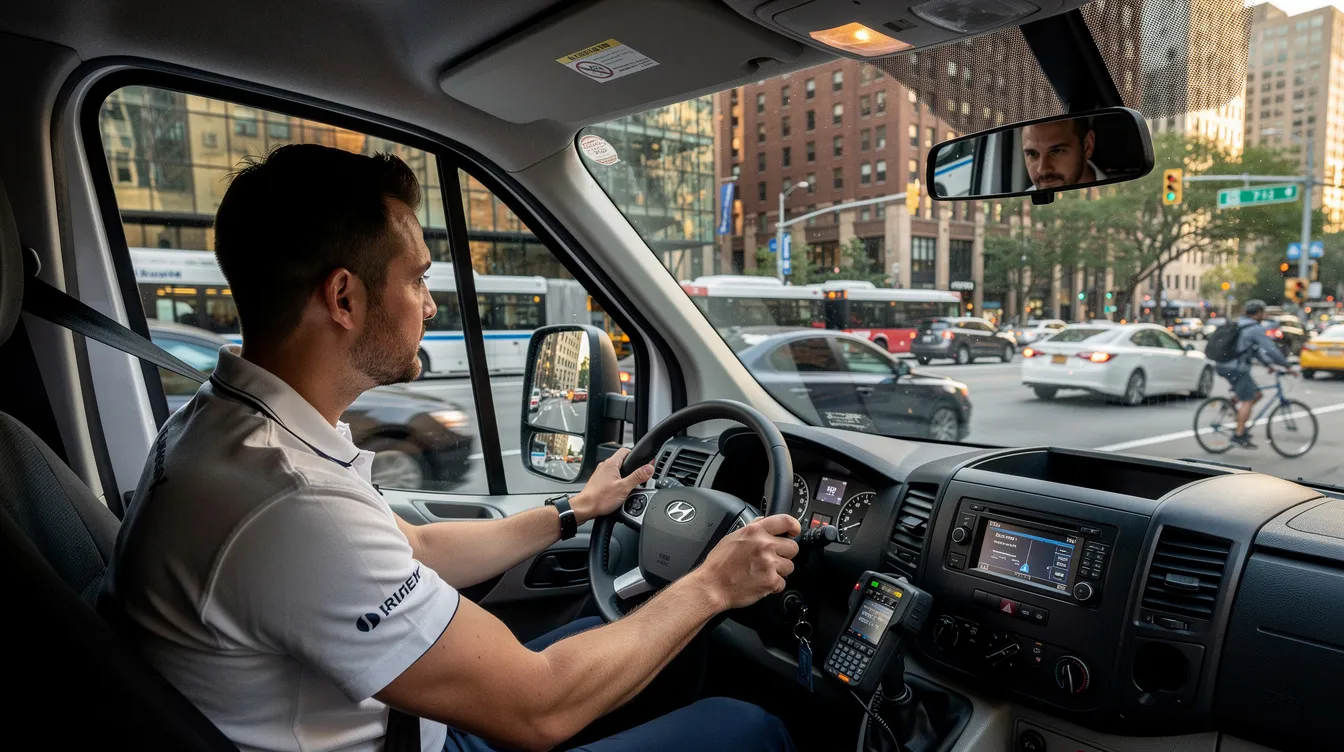
Avoid Distractions: Put the Cell Phone Away
Distracted driving is a major safety risk for anyone who drives for work. In 2024, 315,167 people were injured in crashes involving distracted drivers, according to NHTSA.
Cellphone laws vary by state. As of 2026, 33 states and Washington, D.C., prohibit all drivers from using hand-held cellphones while driving, while 49 states and D.C. prohibit texting by all drivers.
But phones are not the only distraction. Eating, drinking, adjusting vehicle controls, reaching for objects, and interacting with passengers can also take your attention away from driving.
NHTSA notes that reading or sending a text can take your eyes off the road for about five seconds. At 55 mph, that is roughly the distance of an entire football field traveled without looking at the road.
To reduce distractions:
- Silence notifications or use a “Do Not Disturb While Driving” feature.
- Set your destination before starting the vehicle.
- If you use a mounted device for navigation, make sure it does not block your view and complies with state law.
- Do not type addresses, send messages, or handle your phone while driving.
- If you need to make a call, send a message, or change navigation information, pull off the roadway and park in a safe location first.
- Avoid eating, searching for items, or performing other tasks that take your hands, eyes, or attention away from driving.
NIOSH recommends that employers adopt and enforce clear policies to prevent distracted driving among workers.
For a delivery driver or other worker who spends hours on the road, even a brief distraction can mean missing a red light, pedestrian, cyclist, or sudden traffic slowdown.
Drive Sober, Rested, and Focused Every Shift
Workers who drive long distances or work late nights, early mornings, or irregular shifts may be particularly vulnerable to fatigue. Drowsiness can reduce alertness, slow reaction time, and impair judgment.
- Never drive impaired. Do not drive after drinking alcohol, using illegal drugs, or taking medications or other substances that impair your ability to drive safely.
- Read medication labels carefully. If a medication may cause drowsiness or impair driving, talk with a doctor or pharmacist and make other transportation arrangements when necessary.
- Aim for 7 to 9 hours of sleep each day. NIOSH recommends this range for workers who drive.
- Pay attention to warning signs of fatigue, such as frequent yawning, difficulty keeping your eyes open, drifting within your lane, or not remembering the last few miles you drove.
- If you become dangerously tired, stop driving and pull over somewhere safe.
Sleep deprivation can significantly impair performance. NIOSH cites research finding that after about 17 consecutive hours awake, impairment may be comparable to a blood alcohol concentration of 0.05%.
Fatigue is also an occupational safety issue beyond driving. OSHA reports that overall accident and injury rates are about 30% higher during night shifts than during day shifts.
On long drives, take regular breaks. OSHA guidance recommends getting out of the vehicle approximately every two hours to walk and stretch.
Caffeine may temporarily improve alertness, but it does not replace adequate sleep. If you are too tired to drive safely, tell your supervisor rather than trying to push through the fatigue.
Adjust to Road, Traffic, and Work Zone Conditions
Road conditions can change quickly during a workday. Construction, heavy rain, fog, debris, lane closures, and sudden traffic backups all require additional attention.
Work zones deserve particular caution. In 2024, 850 people were killed in work-zone crashes. Large trucks or buses were involved in about 31% of fatal work-zone crashes, while rear-end collisions accounted for about 22%.
When driving through a work zone:
- Slow down and obey posted speed limits and warning signs.
- Leave additional space between your vehicle and the vehicle ahead.
- Watch for workers, pedestrians, equipment, and changing lane patterns.
- Avoid distractions and sudden lane changes.
- Check blind spots carefully before merging.
- Follow flaggers’ instructions and temporary traffic controls.
Weather can also significantly affect driving conditions. FHWA estimates that weather-related crashes accounted for about 12% of motor vehicle crashes annually during the five-year period from 2019 through 2023.
In bad weather:
- Reduce your speed on wet, icy, snowy, or low-visibility roads.
- Increase following distance.
- Use headlights when visibility is reduced, as required by state law.
- Avoid sudden braking, acceleration, and sharp steering on slippery surfaces.
- Avoid using cruise control when conditions are slippery or traction is uncertain.
- Watch for standing water, potholes, gravel, debris, and uneven pavement.
When approaching stopped emergency or roadside vehicles with flashing lights, follow the Move Over law in the state where you are driving, slowing down and changing lanes when required and safe to do so.

If a Crash or Work Injury Happens: Protect Your Health and Know Your Options
Even when you drive carefully, crashes can still happen. If you are involved in one while working, focus first on safety and your health.
- Stop in a safe location when possible and follow state requirements for remaining at or moving from the crash scene.
- Call 911 if anyone appears seriously injured or there is another emergency.
- Turn on your hazard lights. If you are trained, equipped, and it is safe to do so, use appropriate warning devices according to your employer’s procedures.
- Seek prompt medical attention if you are injured or concerned about symptoms, even if they initially seem mild. Some symptoms may not be immediately apparent after a crash.
- Exchange required information with the other driver and document the scene when it is safe to do so.
- Take photos of vehicle damage, road conditions, traffic signs, and other relevant details.
- Get contact information from witnesses when possible.
- Notify your employer promptly and follow its procedures for reporting a work-related crash or injury.
Depending on state law, your employment status, and how the crash occurred, a work-related driving injury may raise questions involving workers’ compensation, a claim against another driver, or other legal options. Rideshare drivers, delivery workers, contractors, and other workers may face additional questions about employment status and insurance coverage.
Employers can also reduce workplace driving risks by verifying that employees are properly licensed for the vehicles they operate, maintaining work vehicles, providing regular driver-safety training, and establishing clear policies on distracted, impaired, and fatigued driving. OSHA and NIOSH both encourage comprehensive workplace motor vehicle safety programs that address driver behavior as well as vehicle condition.
This content was created with the assistance of AI and is provided for general informational purposes only. It does not constitute legal advice. For guidance specific to your situation, please consult with a licensed attorney.